What is character? Why is it that some types of character are more sought after than others? What can a person do to build strong character? At the root of a human’s identity lies their character – encompassing all that they represent, the things in which they prioritize, the people and places they love, and most certainly the activities that occupy their time and energy.
I recently read an excerpt from an article written by David Brooks published in the New York Times titled “The Moral Bucket List.” In this piece, Brooks discusses the vast differences between ‘Resume Virtues’ and ‘Eulogy Virtues’ – the synopsis of which being that Resume Virtues are tied to materialistic things and values, whereas Eulogy Virtues are values of the purest nature, a set of character traits that individuals wish to be remembered by at their funeral.
I often find myself wondering what I will someday be remembered for. Something good, or even great? Or, just the opposite? There is no way to know for certain – only steps that I can take in order to increase the odds of a positive, complimentary eulogy when that time comes.
Working in the field of education, characters of all forms are made present to me on a daily basis. Often, I sit and ponder the path an individual has taken (or may be currently trucking along) that has led them to present themselves as they do. By this, I don’t simply imply that a person’s appearance is a tell-all to what lies at their core – in fact, I mean just the opposite.
In conversation, I make a concerted effort (almost always) to listen – truly listen, to what is being shared with me. Be it a student, a co-worker, an athlete, or any other discussion I may encounter throughout my day-to-day life. I’ll get to the importance of listening in just a moment. For now, I want you to consider the most recent conversation you had, with anyone. Were you present? Did you truly listen? What did you take away from this conversation?
Recently, I had a really powerful conversation with an athlete of mine. This young man had just wrestled his final high school wrestling match, losing by a score of 9-8, yet still placing 8th at the Iowa High School State Tournament — an outstanding accomplishment to most, particularly someone who took the path that he had followed to this point. I’ll touch on this more shortly.
In a time of despair and defeat, he looked to me for answers, of which I admittedly had none. What do you say to a person that just closed such an important chapter in their book of life? How do you take the pain away? The simple answer is that you don’t – you simply can’t. This is a hard lesson that I learned rapidly in my still green career as a coach. Furthermore, this is a lesson that I learned through watching this very same athlete live his life, and listening to his story.
For the sake of anonymity, I’ll refer to this athlete of mine as Charlie. To an outsider looking in, Charlie is just like any other 17 year old kid – except, in many ways he is nothing like his peers. Having only been in my current position for now approaching two full years, I didn’t have the pleasure of knowing Charlie from a younger age, more less the entirety of his high school career. Leading up to Charlie’s senior year of high school, he had spent three consecutive seasons on the second or third-string wrestling teams. His time to step into the starting varsity lineup came this most recent season – and, as I previously stated, Charlie made the most of this opportunity. To most, this is a “feel-good” story. One of those stories that earns praise from large crowds, because who doesn’t love an underdog?
To me, Charlie’s story represents so much more. In the simplest terms possible, his story represents the cliche term; “never give up.” But, what does it truly mean to never give up? What did it mean for Charlie to never give up? To never give up when he was losing more matches than those in which he was victorious? To never give up when he was overlooked by peers, fans, teammates? I’m sure the list could go on.
The core of Charlie’s eventual success in the sport of wrestling roots itself in one simple act – showing up. [Something both overlooked and undervalued in all facets of society today.] To show up, when the odds are stacked against you, to show up when you feel broken, to show up when you feel like letting go of something that seems to take more than it gives. The path that Charlie chose, time and time again was the path to showing up. The path to what I consider to be the noblest of character.
In late January of this year, on a Thursday morning, I found myself in the wrestling room. The clock showed at 5:50 am. At this given moment, it was just Charlie and me. I was admittedly sipping on my coffee, as Charlie was preparing to take off a few pounds in order to make weight for that night’s dual meet. As I sit, quietly observing, as he sheds weight for what is likely to be one of the final times, I begin to conceptualize the magnitude of his accomplishments. The power in his commitment, his loyalty, his willingness to continually show up – the power in his character.
This memory is what enters my mind in Charlie’s moment of heartbreak, when nothing could (really) ease the pain that ensues when the realization hits, that this is goodbye. Goodbye to something that has consumed so much within you. To something that you gave so much to attain. … In this moment, as I fumble over my own thoughts – as the memory of Charlie pouring his heart and soul into this thing once more crossed my mind, the only words that I left him with was the assurance that he, in a very brief period of time, made an immense impact on my own outlook on life and my perception of what it means to house the level of character that is associated with Eulogy Virtues.
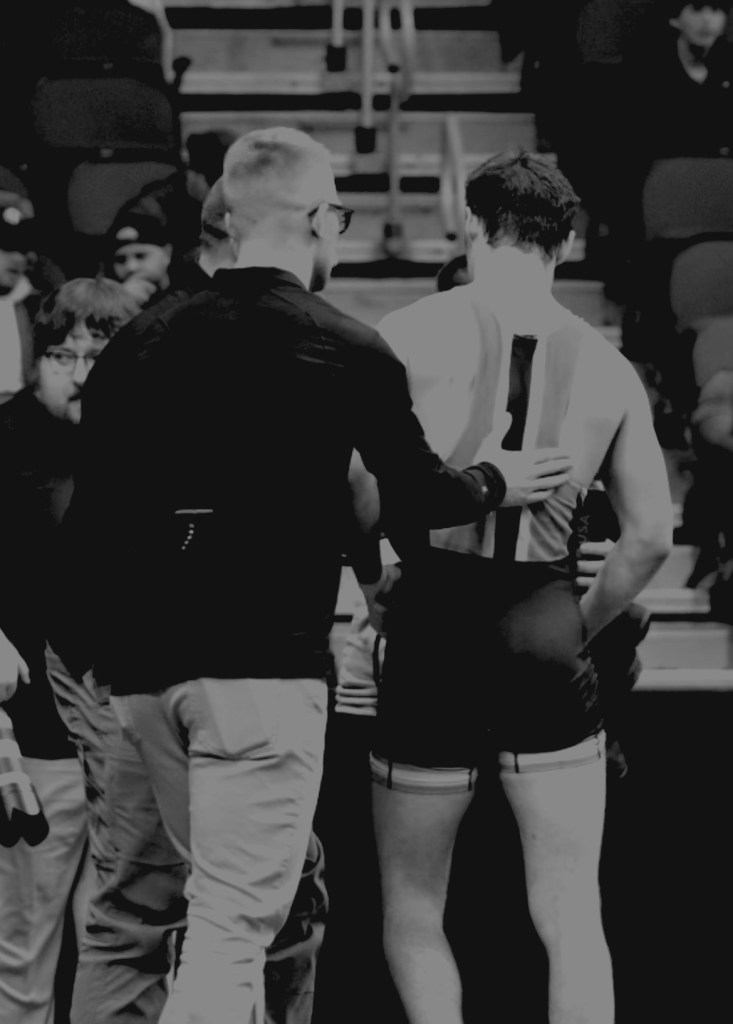
To Charlie, it was never about the status, nor the recognition (Resume Virtues) – but rather the little moments of gratification and the beauty of the process itself. The path he chose, after total commitment and follow-through, remained steadfast, against all odds and days of exhaustion and depletion. To revel in the memory of it all. These are the building blocks that one can utilize to produce an undeniable body of work that is authentic character.
To answer the question of “what is character?” You must first understand that character isn’t some “thing,” but rather a plethora of experiences, motives, decisions and actions that compose an individual’s current state. Where they stand in relation to the humans forming society around them. Character is what sets someone apart from another. To take the path(s) to truly profound character is to legitimize what it is that you want to be remembered by, and to carry those standards with you in all that you do.


 Forged in Fire
Leave a reply to Erin Carpenter Cancel reply